what is the average temperature in the arctic circle
Arctic Circle is already recording 118 F degree days (and summer is just heating plant up)
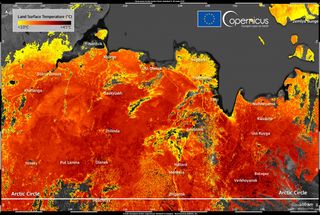
On the summer solstice (June 20 — the longest solar day of the year) two EC satellites recorded a scorching temperature of 118 degrees Fahrenheit (48 degrees Celsius ) on the ground in Cold Siberia.
This isn't quite a new heat record; atomic number 3 a post on the EU's Copernicus satellite website noted, this egg-boiling temperature was detected just connected the solid ground in Siberia's Sakha Republic, while the region's air out temperature (the temperature populate would in reality feel while walking around) was a toasty 86 F (30 C).
However, that's still an anomalously high temperature for the Arctic Round — and one that could exacerbate the region's melting permafrost, which is the only thing preventing ancient caches of nursery gases from reentering World's atmosphere, accordant to Gizmodo.
Related: 10 signs Earthly concern's climate is bump off the rails
The EU's Copernicus Sentinal-3A and 3B satellites recorded the high temperatures in the thick of an ongoing heat wave complete much of Siberia. The heat spike is, unfortunately, a predictable originate in to summertime, following a spring that power saw hundreds of wildfires hot the Siberian countryside and blacking out major cities with blankets of smoke.
Many of these springiness fires were "zombie fires," indeed called because they are thought to be the rekindled remains of wildfires that enkindled the previous summer and were never fully extinguished. The zombie fires smoldered for months under winter tras and snow, fed by the carbon-deluxe peat below the surface. When the spring melt arrived, the old fires blazed afresh, Live Science previously reported.
If last summertime is any indication, the hot solstice temperatures are just the beginning. Precisely one year ago, on June 20, 2020, the similar region of Siberia recorded the freshman 100 F (38 C) day above the Arctic Roofy — the hottest temperature ever tape-recorded there. The sweltering day in Siberia fits into a larger climate change trend. For years, average temperatures in the Arctic have been rising at a far quicker rate than anywhere else along Earth, for the most part due to melting sea ice induced by synthetic global warming.
Originally published on Live Scientific discipline.

Brandon has been a senior writer at In play Science since 2017, and was formerly a stave writer and editor at Reader's Digest magazine. His composition has appeared in The Washington Stake, CBS.com, the Richard Dawkins Base website and other outlets. He holds a bachelor-at-arms's degree in creative writing from the University of Arizona, with minors in journalism and media arts. Helium enjoys writing all but active space, geoscience and the mysteries of the macrocos.
what is the average temperature in the arctic circle
Source: https://www.livescience.com/arctic-circle-siberia-hot-day-2021.html

Posting Komentar untuk "what is the average temperature in the arctic circle"